
 COLREG trainer · iPhone, iPad and Mac
NavCraft: a COLREG trainer that teaches you to decide, not to memorise
Not another question bank. NavCraft draws every vessel from the geometry of the Rules so you can walk round her lights, asks night encounters from her lights alone, makes you reason before it shows the options, asks how sure you are, and spaces it all to your exam date. All 41 rules and 4 annexes of COLREG 1972, on iPhone, iPad and Mac.
- 360°lights from any angle
- 1,100+questions, drawn fresh
- 41 + 4rules and annexes
- 3narrated languages
- 7lessons free for good
What a question bank and a light card can’t do
Most COLREG study is a pile of multiple-choice questions and pictures of lights from four sides. NavCraft is built on how people learn to decide, and on how the Rules are tested on the bridge and in the oral exam.
| The usual way | NavCraft | |
|---|---|---|
| Lights | A picture of each vessel from ahead, astern and the beams | Every vessel drawn from the arcs in the Rules. Walk round her and each light comes and goes at its exact limit |
| Encounters | Who gives way, read from a diagram | Night encounters shown as nothing but her lights on a steady bearing: name her, read her heading, decide |
| Answering | Four options from the start, so you recognise rather than recall | Work it out first: which rules apply, what encounter it is, your duty. Then the options |
| Mistakes | A red cross, and on to the next question | Say how sure you were. Mistakes you were certain about come back at a later sitting until they are fixed |
| Revision | Random questions, or the same order every time | Spaced reviews timed to your exam date by a scheduler fitted to your own memory |
| Look-alikes | Mixed in by chance | Asked back to back: NUC beside RAM, Rule 34 beside Rule 35, the same encounter in sight and in fog |
| Sound signals | Dots and dashes, or one beep for every ship | Real blast lengths, the whistle pitch Annex III gives for her size, and a horn you sound yourself |
| Readiness | Percentage right so far | A pass chance weighted the way the exam paper is set |
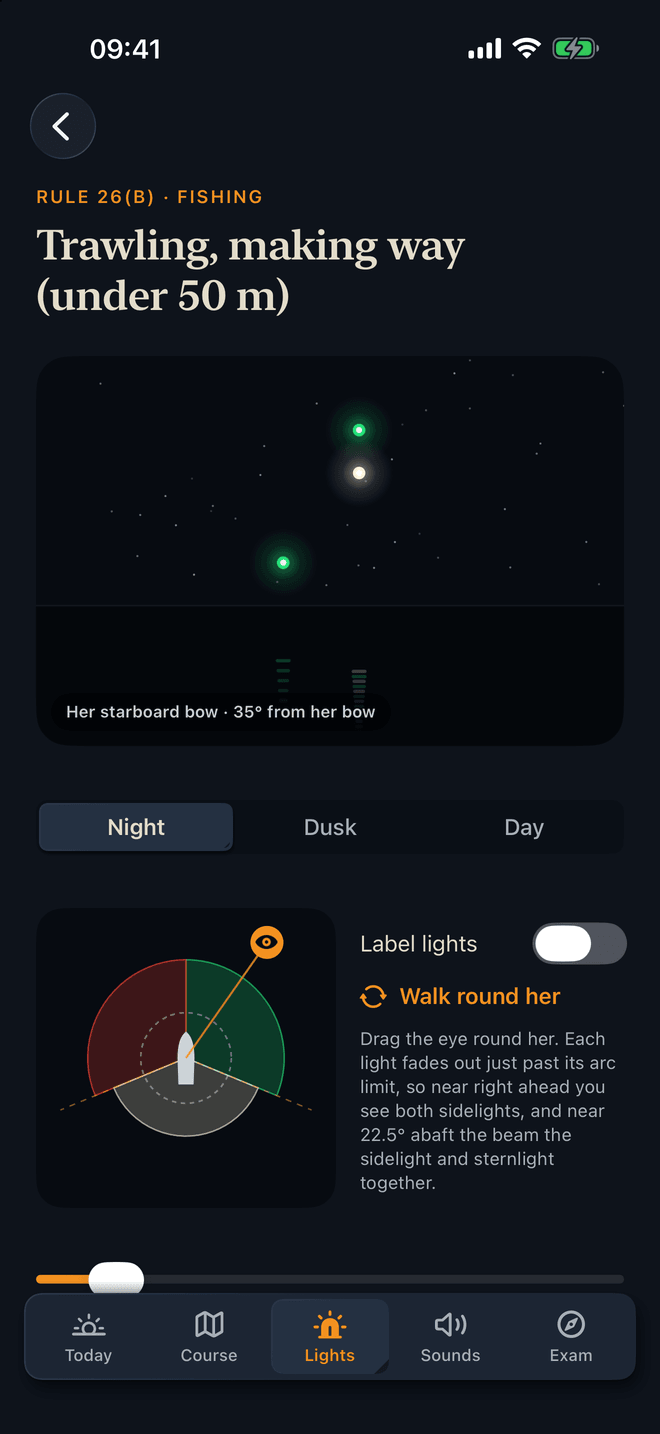
Walk round any vessel and watch her lights change
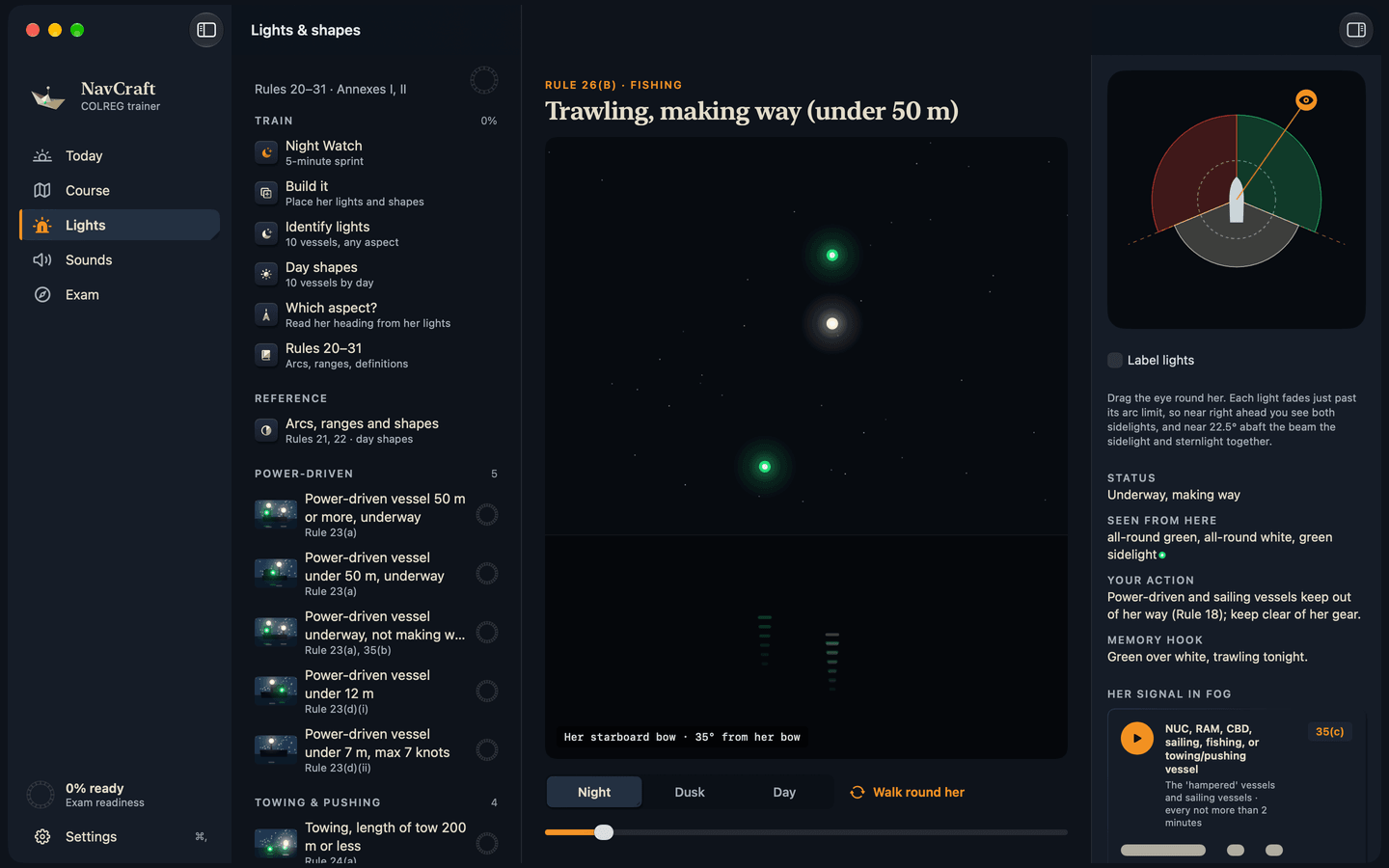
A light card shows a vessel from four sides. At sea she is wherever she happens to be. NavCraft draws each vessel from the geometry of Rule 21, so as you turn the dial her masthead light, sidelights and sternlight come and go exactly where the Rules put them: 225° ahead, 112.5° each side, the last 135° astern. Near right ahead you see both sidelights; near 22.5° abaft the beam, the sidelight and the sternlight together.
- Every vessel in Part C: power-driven, sailing, fishing, towing and pushing, NUC, RAM, CBD, pilot vessels and vessels at anchor.
- Night, dusk and day, so the shapes are learned with the lights.
- Build it: place a vessel’s lights and shapes yourself, then check them.
- Night Watch: five-minute sprints aiming at 95 % right in under three seconds.
Decide from her lights alone, like on the bridge
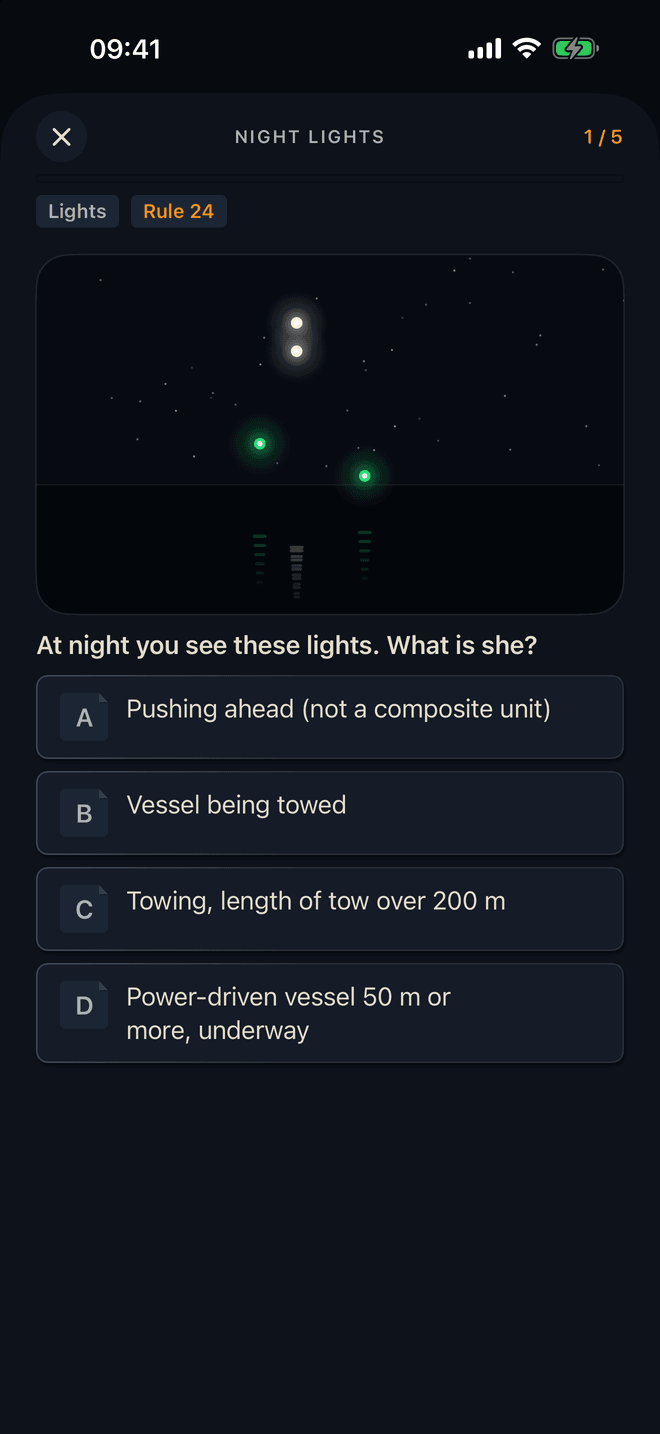
On watch you never get a diagram with arrows. You get two white lights and a green one, closing on a steady bearing. NavCraft’s night encounters show exactly that and ask the whole task at once: what she is, which side of her you see, and what you do. It is the way an oral examiner asks it.
- Work it out first: the reasoning comes before the options, worked for you at first and handed over to you as you learn.
- Radar encounters in fog, where nobody stands on and Rule 19 decides.
- Every item is drawn fresh, with a new aspect and bearing, so you learn the rule, not the picture.
The stand-on vessel’s dilemma, stage by stage
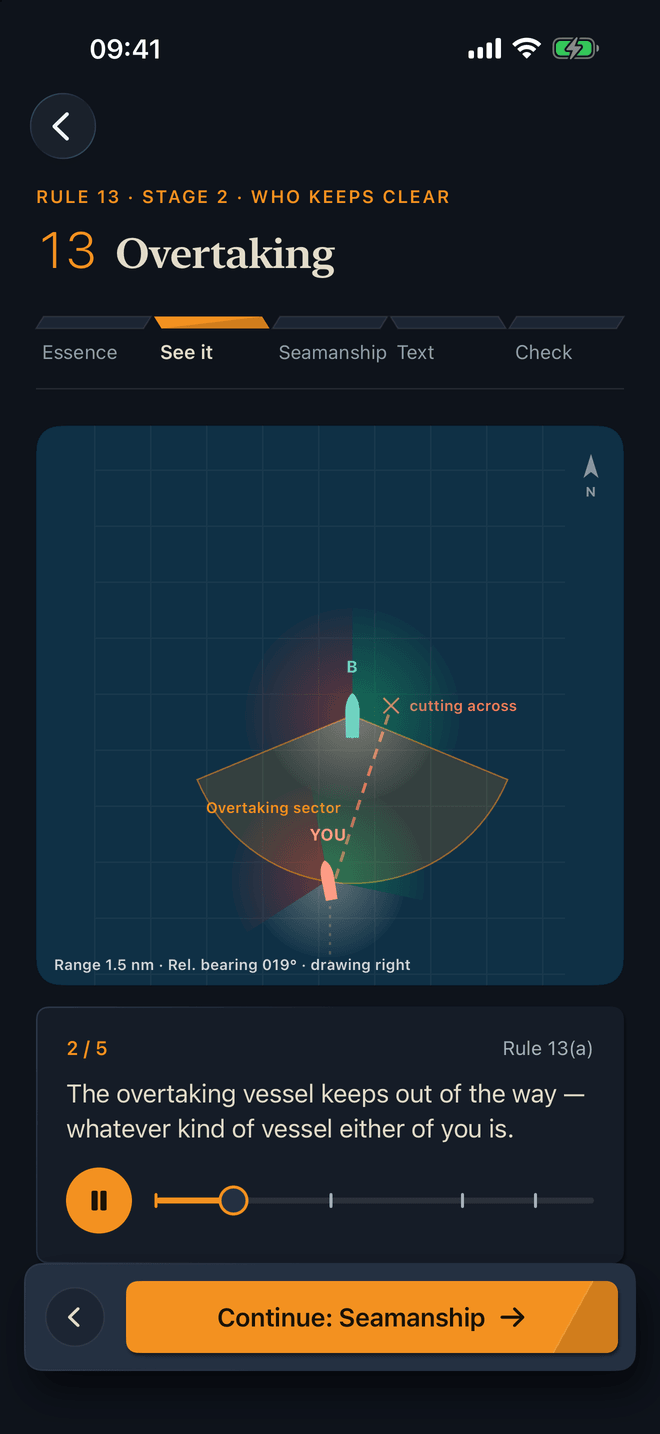
The hardest call in COLREG is not who gives way but when the stand-on vessel stops standing on. NavCraft plays Rule 17 as it unfolds on one encounter: keep your course and speed, then the doubt signal when she does not act and you may manoeuvre, then the moment you must, and never to port for a vessel on your port side. Overtaking, crossing and head-on situations are animated the same way.
- Rule 17(a)(i), (a)(ii) with the Rule 34(d) doubt signal, then 17(b) and (c).
- The 22.5° overtaking boundary by night and by day, and “until finally past and clear”.
- Rule 18 responsibilities, narrow channels and traffic separation schemes.
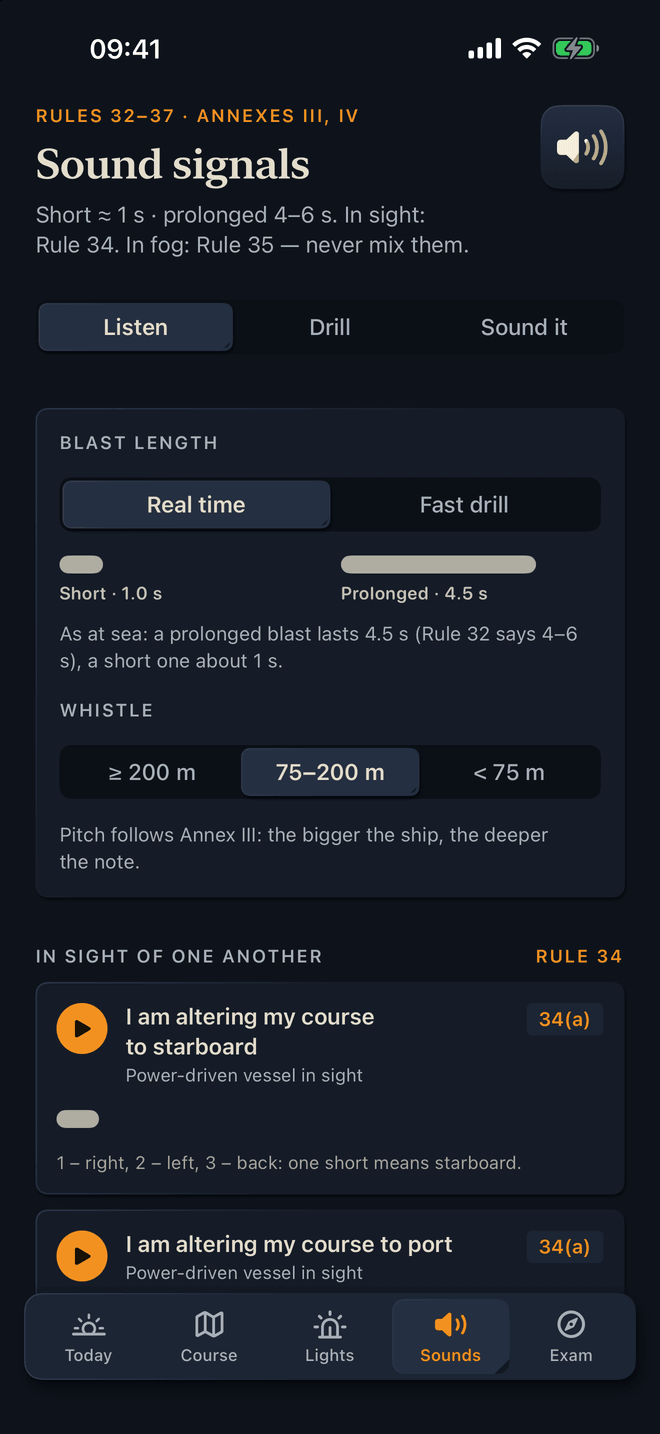
Sound signals as they really sound
A short blast lasts about one second; a prolonged one four to six. NavCraft plays every manoeuvring, warning and fog signal at those lengths, with the whistle pitch Annex III gives for a vessel of her length, so a VLCC sounds like one. Then you sound them yourself on the horn trainer, and “Fog signals: hear it, name it” drills them by ear.
- Rule 34 in sight of one another beside Rule 35 in fog: the same pattern, a different meaning.
- Rule 35 fog signals for every kind of vessel and status.
- Rule 37 and Annex IV distress signals.
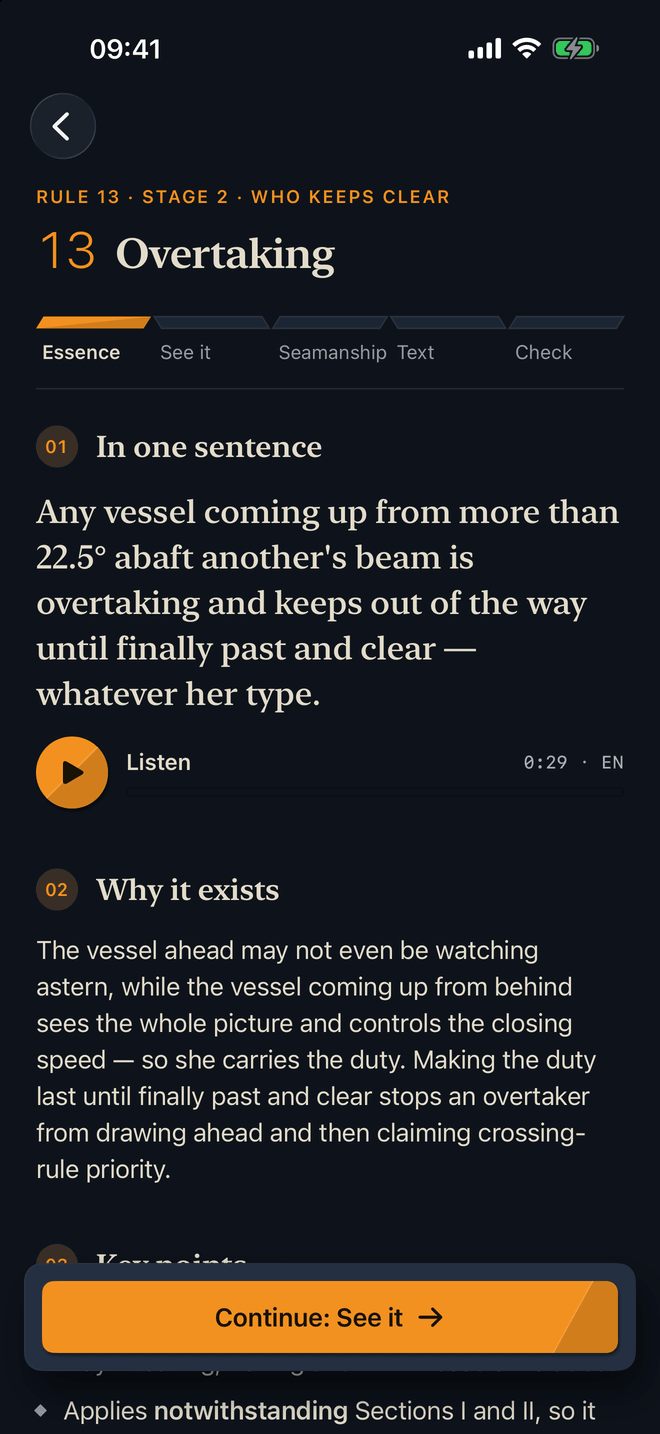
Lessons written on the bridge, read aloud in three languages
Every rule starts with three questions to try before you read it, because guessing first makes the lesson stick. Then the rule in one sentence, read aloud in English, Ukrainian or Russian; the situation animated; seamanship notes from a serving Master with the myths and real collisions behind the rule; the exact wording; and a check. Score 80 % to pass, or the course sends you back.
- The essence of every rule written and narrated in English, Ukrainian and Russian.
- Seamanship notes, common myths and real collisions for each rule.
- Daily watches ask only what you have passed, in the order you learned it.
It asks how sure you are, and remembers when you were wrong
A lucky guess and a firm answer look the same on a score sheet. In NavCraft every answer carries a rating: guess, fairly sure, or certain. A mistake you were certain about is the dangerous kind, so it goes to Blind spots and heads the next day’s watch until you get it right at a later sitting. A calibration panel shows whether your “certain” really means certain.
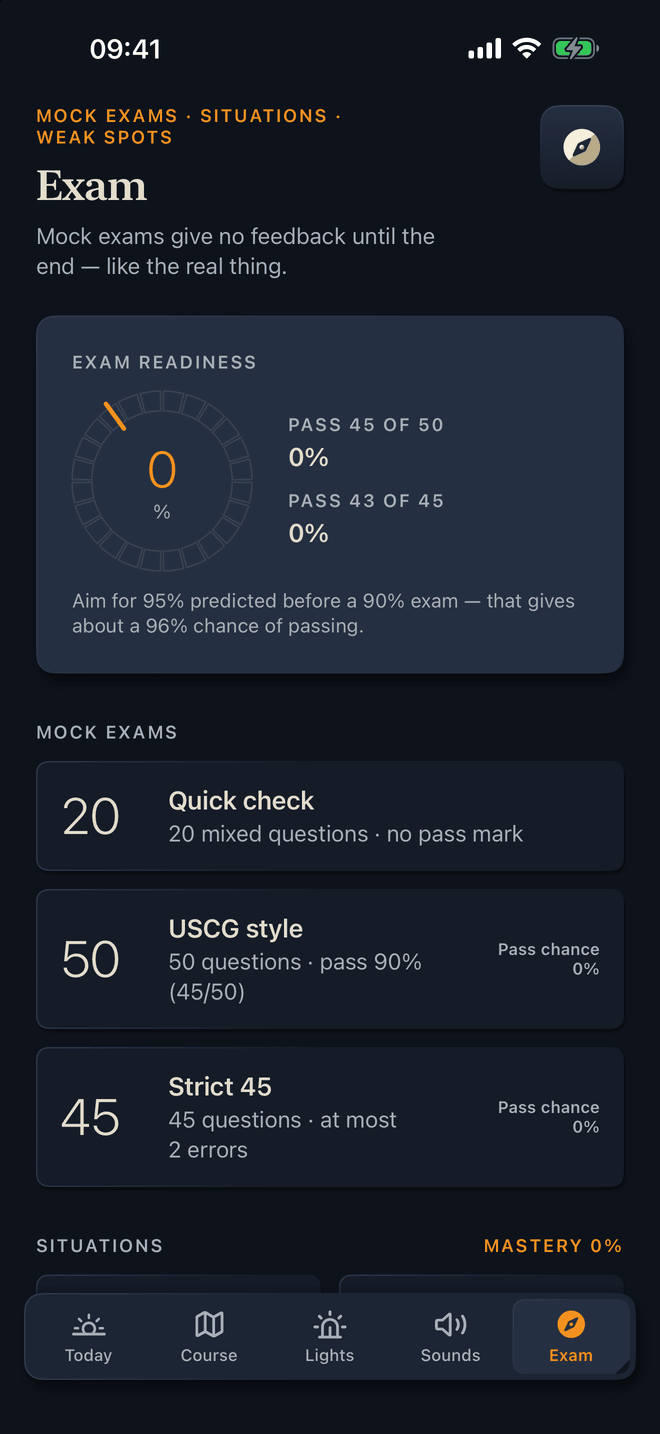
- Mock exams marked only at the end: a 20-question check, a 50-question paper at 90 %, and a strict 45 with two errors allowed.
- A predicted pass chance weighted the way the paper is set: rules, lights, shapes, sounds and situations.
- Optional certainty marks in mock exams, with the certainty-based scoring developed for medical students at UCL.
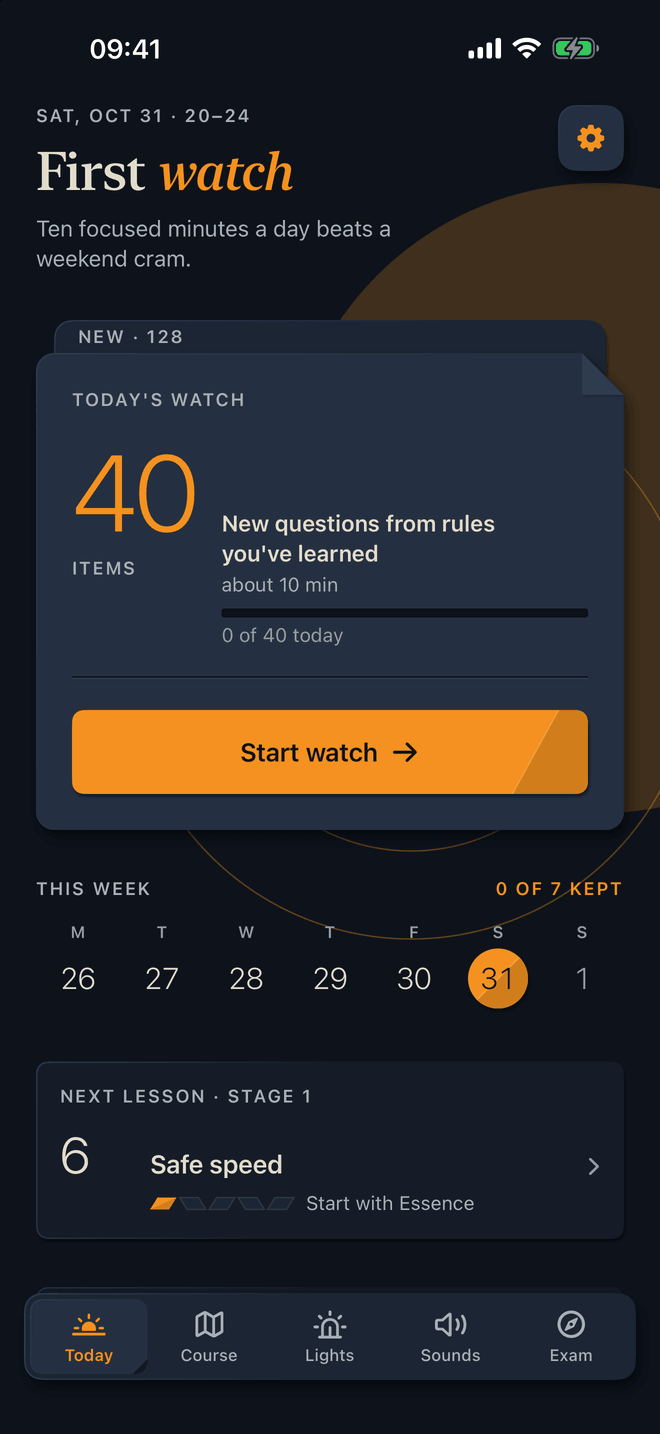
Ten minutes a day, timed to peak on exam day
Set your exam date and NavCraft spaces every review so your memory is strongest on that day. The scheduler is FSRS-6, and after 400 or so answers it fits itself to how you forget. Today plans about ten minutes of new questions and due reviews. Between sessions, quick questions arrive as notifications you answer with A–D buttons without opening the app.
- Misses come back in the same run until answered right, and again ten minutes later.
- Topics are mixed so you learn to tell them apart, not to guess the chapter.
- A daily reminder and a tip of the day, on a long contract or ashore.
The method behind it, in eight pieces
Each one comes from learning research on retrieval, spacing and feedback, and each is in the app today.
Look-alikes drill
A vessel next to the ones with nearly her lights, a signal next to its near twins, an encounter next to the same picture in fog.
Try first
Three questions before each new lesson. Getting them wrong first is what makes the lesson stick.
Mastery before moving on
A lesson counts as learned only when its check reaches 80 %. No skipping ahead with gaps behind you.
Blind spots
Every answer you were sure of but got wrong, listed by rule until you have fixed it on another day.
A scheduler fitted to you
FSRS-6 spaced repetition, refitted weekly to your own answers once there are enough of them.
Never the same picture
Lights, shapes, sounds and encounters are generated afresh each time: new aspect, bearing and geometry.
Horn trainer
Sound the signal yourself, with the right blast lengths, instead of only picking it from a list.
Answer in the notification
Quick questions on the lock screen with A–D buttons. A minute of retrieval while the kettle boils.
On the phone on the way to the ship, on the Mac before the exam
One purchase or subscription covers every device on your Apple Account. Progress syncs through your own iCloud, and the Mac version has the course sidebar and a large lights view for the evenings before the exam.
For everyone who keeps a lookout
From the first COLREG lecture at the academy to the Master refreshing fog signals before a new trade.
Deck cadets
Learn the Rules properly the first time, from Rule 1 to Annex IV.
Officer of the watch candidates
The COLREG part of the OOW written and oral exams, with mock papers.
Masters and mates
Refresh lights, shapes and fog signals before an audit, a new trade or a pilot exemption.
Yachtmasters and skippers
Read lights at night and know who gives way, under sail or power.
Licence candidates
Practise for national exams built on COLREG 1972, such as the USCG’s.
Recreational boaters
Understand what the big ships around you are doing and what they expect of you.
The whole of COLREG 1972, rule by rule
NavCraft follows the Convention’s own order, so what you learn lines up with the book on the bridge and with your syllabus. Seven lessons are free for good: Rules 1, 2, 3, 5, 6, 7 and 8.
Read all 41 COLREG rules and 4 annexes, each in one sentence, on the NavCraft site, in English, Ukrainian and Russian.
- Part A
- General: application, responsibility, definitions (Rules 1–3)
- Part B
- Steering and sailing in any visibility, in sight of one another and in restricted visibility (Rules 4–19)
- Part C
- Lights and shapes (Rules 20–31)
- Part D
- Sound and light signals (Rules 32–37)
- Parts E and F
- Exemptions, and verification of compliance (Rules 38–41)
- Annexes I–IV
- Positioning of lights, fishing signals, sound signal appliances, distress signals
Free to start. Then monthly while you study, or once for good
The free part stays free. A 7-day trial opens everything with no charge, and nothing renews when it ends. Then keep the full course with a monthly subscription, or buy it once and share it with your family. No account and no ads, either way.

US prices. The App Store shows the price in your own currency.
| Option | Price |
|---|---|
| Free part: seven lessons, power and sail lights, manoeuvring signals, daily watch | Free |
| 7-day trial of everything, nothing renews | Free |
| Full course, monthly | $2.99 / month |
| Full course for life, with Family Sharing | $39 once |
Private, offline and in your language
Data not collected
No account, no analytics, no ads. Your progress stays on your devices.
Synced through your iCloud
Start on the iPhone, carry on on the iPad or Mac, through your own private iCloud.
English, Ukrainian, Russian
Every rule’s essence is written and read aloud in all three.
Works offline
Lessons, questions, lights, signals and narration are all on the device. No signal needed at sea.
Written by a Master who still keeps the Rules every watch
NavCraft is made by Dmytro Mayevsky, Master Mariner, who also builds the Bridge Con officer of the watch app, the free AMVER report generator and ShipETA Pro on this site. Bridge Con identifies a vessel from her lights while you are on watch; NavCraft teaches the Rules, so you already know her.
The way NavCraft teaches is written down and checked against the research: retrieval practice, spacing, interleaving, certainty-based marking, worked examples that fade, and mastery before moving on. None of those studies used COLREG learners, so each is applied with a watchkeeper’s judgment, and every question was audited so the wrong options can’t give the right one away.
NavCraft is a study aid. Where it differs from the official COLREG text, the official text prevails.
NavCraft COLREG trainer — frequently asked questions
What is NavCraft: COLREG Trainer?
What makes NavCraft different from other COLREG apps?
Is NavCraft free?
Which exams does it prepare you for?
How does NavCraft teach navigation lights?
Does it work offline at sea?
Which devices and languages does it support?
How is NavCraft different from the lights identifier in Bridge Con?
Where can I read the rules before installing?
What happens to my data?
Take the Rules of the Road to sea
Free on the App Store for iPhone, iPad and Mac, with seven lessons free for good and a 7-day trial of the rest.
More on colreg.navcraft.app